What is FDE?
What is an FDE? Learn how Forward Deployed Engineers turn customer problems into production AI systems, and how technical professionals can move into the role.
 AI FDE Team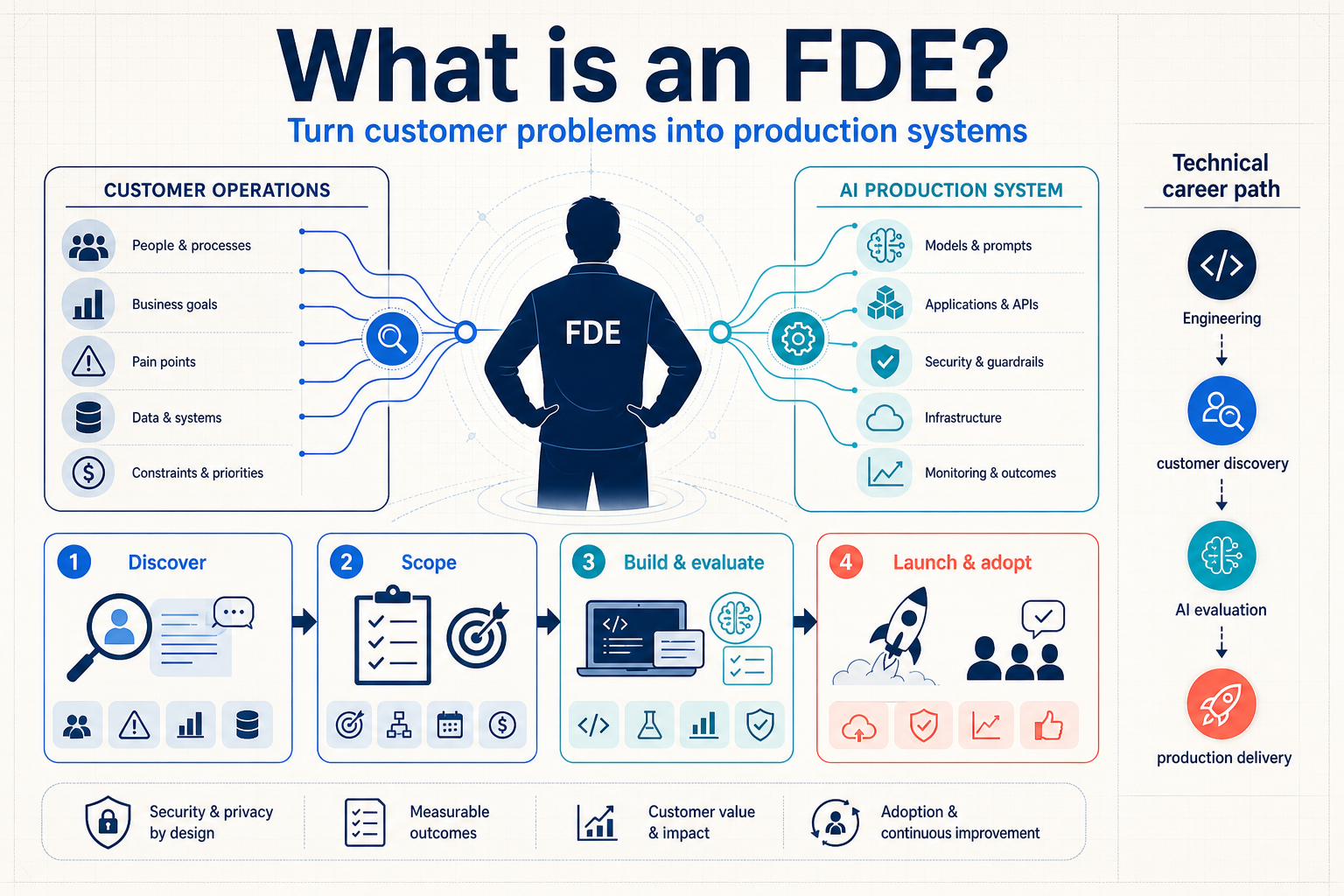
What is FDE?
FDE stands for Forward Deployed Engineer. An FDE is neither an engineer who only writes code near a customer nor a consultant who stops at a slide deck. The role works with customer teams to find a problem worth solving, turn it into a deliverable system, and stay accountable until real users can rely on it.
The short definition is simple: an FDE turns customer problems into usable, measurable, maintainable production systems.
AI makes that responsibility broader. A model producing a plausible answer does not mean it is ready for a business workflow. Data access, permissions, evaluation, failure handling, rollout, and adoption are all part of the AI FDE's delivery surface.
FDE work starts before implementation
Many technical projects begin with a requirements document. FDE work often begins one step earlier: what, exactly, should change for the customer?
Suppose a customer asks for an AI support assistant. Before choosing a model or building a chat interface, an FDE needs to establish:
- which requests consume the most time and who will use the system;
- which data is accessible and which data must never reach the model;
- what success means, such as resolution rate, handling time, or adoption;
- what happens when the model is uncertain;
- how narrowly the first release should be scoped.
This is customer discovery and problem framing. It determines whether the engineering work solves the right problem.
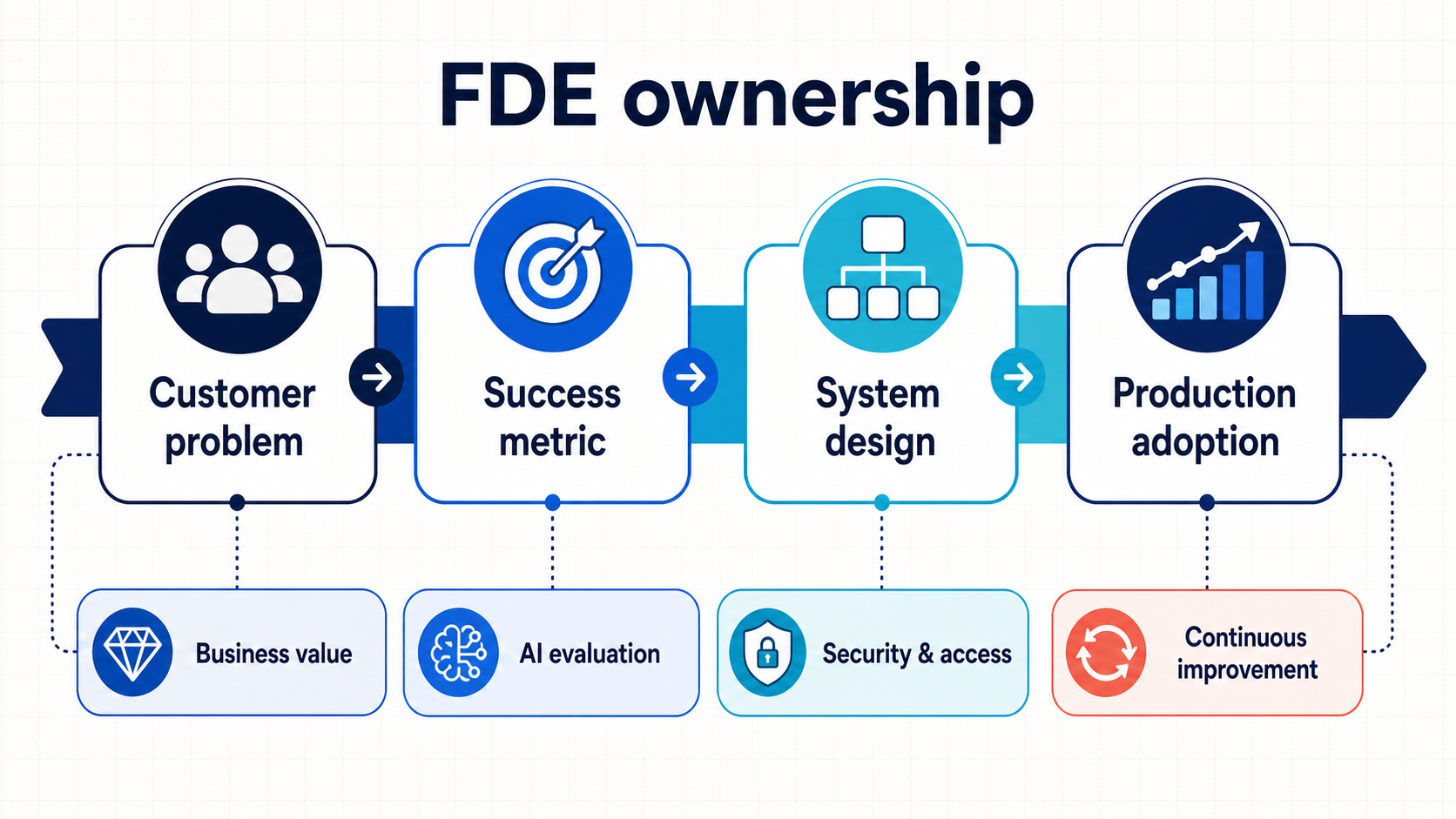
The four-part FDE delivery loop
The four stages in the infographic are not a one-way conveyor belt. Evidence from production should change the earlier decisions about scope, design, and evaluation.
- Discover: observe the workflow and speak with users, business owners, data teams, and security teams to identify a valuable, feasible bottleneck.
- Scope: convert an ambiguous request into goals, constraints, acceptance criteria, priorities, and explicit trade-offs among speed, cost, quality, and risk.
- Build and evaluate: connect interfaces, APIs, data, permissions, and model capabilities. Evaluate with representative tasks, not only a successful demo.
- Launch and adopt: release to a limited group, observe errors and behavior, prepare human escalation and rollback paths, then support the workflow until it creates a durable result.
The success criterion is not that a model answered one impressive prompt. It is whether a workflow became more reliable or effective, with evidence to prove it.
FDE vs. software engineer vs. solutions architect
The roles overlap and titles vary by company. The more useful comparison is not the label, but who owns the end result.
| Role | Typical focus | Direct ownership of the post-launch customer outcome |
|---|---|---|
| Software engineer | A product, service, or platform capability | Depends on team structure |
| Solutions architect | Discovery, solution design, and implementation guidance | Often shared, but not always continuous production ownership |
| FDE | End-to-end delivery from problem discovery through adoption | Usually yes, including hands-on implementation and issue resolution |
Strong FDEs are strong engineers. The distinction is not that they communicate instead of coding. They own the loop that links customer understanding, technical judgment, implementation, evaluation, and adoption.
How OpenAI describes FDE
OpenAI's current Forward Deployed Engineer role description places the team at the intersection of customer delivery and core platform development. It describes ownership across discovery, technical scoping, system design, building, and production rollout, with success measured through adoption, workflow impact, and evaluation-driven feedback.
That is a helpful reference point for AI FDE work. It is not a company-exclusive title or a substitute for reading a specific job description. Industry focus, travel, full-stack depth, and AI stack vary by team, but end-to-end production delivery is the recurring pattern.
Common FDE delivery scenarios
FDE work is defined by the delivery shape, not one product category. A strong FDE can work on a knowledge workflow, an operational workflow, or a decision-support workflow, as long as the team can define the user, the constraint, and the evidence of improvement.
FDE for internal knowledge work
An FDE may help an operations or support team find accurate answers across policies, product documentation, and case history. The first task is rarely “add a chatbot.” The FDE needs to identify the sources that are authoritative, set access rules, create a test set from real questions, and define when the assistant should defer to a person. The system becomes useful only when the answer, source, and escalation path fit the existing workflow.
FDE for operational handoffs
Another FDE project might classify incoming requests, draft a handoff, or extract structured information from documents. Here the FDE needs to map exceptions, approval steps, and downstream systems before automating anything. A good first release may handle only one queue, one document type, or one high-volume decision, then expand after its quality and business effect are visible.
FDE for high-stakes decision support
For finance, health, security, or regulated work, an FDE must make human review, audit trails, and data boundaries part of the design from the start. The FDE does not promise autonomous judgment where verification is required. Instead, the FDE creates a bounded workflow that helps experts review information faster while preserving accountability.
How a technical professional can become an FDE
You do not need to become a generalist overnight. Start with your engineering foundation and deliberately develop the skills nearest to customer outcomes.
1. Move from feature thinking to workflow thinking
Choose a process with real users, not only a general-purpose demo. Identify who is blocked, at which moment, and how improvement will be measured. Internal knowledge retrieval, support triage, and approval assistance can all be useful starting points when there is a real user context.
2. Turn an ambiguous conversation into a technical scope
Practice writing a one-page delivery brief: goal, non-goals, inputs and outputs, data boundary, permissions, success metric, risks, and first-release scope. Much of the value of an FDE is the ability to decide what should not be built yet.
3. Learn to evaluate AI, not only call it
Collect representative tasks and failure cases for your project. Define correct, acceptable, escalate-to-human, and must-refuse outcomes. Track whether each change actually improves quality. In an AI system, evaluation is part of delivery, not a one-time pre-launch test.
4. Take a prototype into production conditions
Complete at least one end-to-end loop: authentication and permissions, logging and monitoring, error handling, cost controls, human fallback, staged release, and user feedback. After launch, observe whether people truly save time, make fewer errors, or complete work they could not complete before.
What an FDE portfolio should show
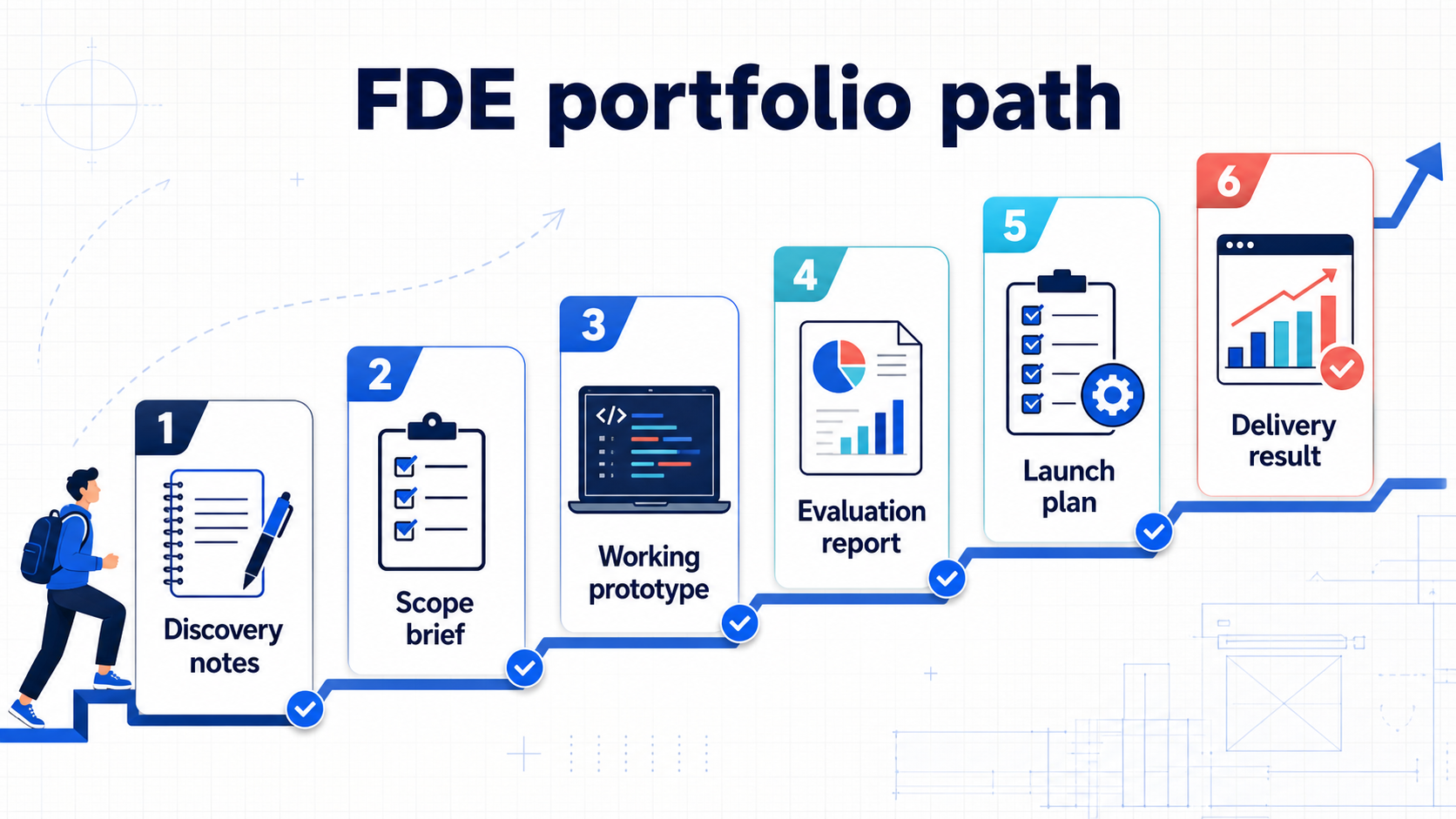
A credible FDE portfolio is more than a code repository and polished screenshots. It should make your judgment visible.
- The problem: users and workflow you observed.
- The trade-offs: why you chose the scope and which ideas you rejected.
- The system: how data, permissions, models, tools, and human review connect.
- The evaluation: test cases, failure categories, quality thresholds, and iteration evidence.
- The rollout: limited release, monitoring, rollback, and support plan.
- The result: the change in user behavior or business metric.
Technical depth remains essential. FDE interviews and delivery work also ask whether you can make safe, explainable decisions while information is incomplete and the project must keep moving.
What is FDE? Frequently asked questions
What is FDE in practical terms?
In practical terms, an FDE is the person who keeps a customer outcome connected to the work needed to achieve it. An FDE can investigate the workflow, choose the first technical scope, write or review the implementation, evaluate behavior, and guide the release. The exact division of labor changes by company, but an FDE is accountable for keeping the delivery connected to real use.
Is an FDE the same as a consultant or embedded engineer?
Not necessarily. An FDE may use consulting skills, and an FDE may work closely with a customer for an extended period. The defining distinction is production ownership. An FDE does not treat discovery or a prototype as the finish line. The FDE stays focused on whether the system is reliable, usable, and adopted in the workflow.
Does an FDE need to write production code?
Most FDE roles expect hands-on technical depth, even when an FDE is working with a broader engineering team. An FDE should be able to judge architecture, integrations, evaluation results, and operational risks. Some FDEs write most of the code themselves, while others coordinate specialists, but a credible FDE cannot delegate away the technical decisions that determine delivery quality.
When should a team involve an FDE?
Bring in an FDE when the problem, stakeholders, data, and production constraints are still intertwined. An FDE is especially useful when a team has a promising AI capability but no reliable path from a pilot to a repeatable workflow. The earlier the FDE helps define success and constraints, the less likely the project is to become a polished but unused demo.
Can a software engineer transition into FDE work?
Yes. A software engineer already has a strong base for FDE work. To become an FDE, add evidence of customer discovery, scoping, evaluation, rollout, and measurable outcomes to your engineering portfolio. The goal is not to stop being an engineer. It is to show that your engineering decisions remain sound when users, constraints, and business outcomes are part of the problem.
What should an FDE learn about AI first?
An FDE should learn how model behavior affects a workflow: retrieval quality, tool permissions, structured outputs, evaluation sets, human review, latency, cost, and failure handling. The FDE does not need to use AI for every step. The more important skill is knowing where AI adds value, where deterministic software is safer, and how to prove that the combined system works.
Where to start
Use the AI FDE learning path to practice discovery, scoping, prototyping, evaluation, productionization, and adoption in sequence. Browse the AI FDE tool directory for common building and evaluation tools. When you are ready, take the AI FDE online exam to identify the field decisions that need more practice.
Finishing one small, real end-to-end project will teach you more about FDE work than collecting another ten tutorials.
Is this an official OpenAI or employer certification?
No. AI FDE is an independent learning and certification community. It is not operated by, endorsed by, or presented as an official credential from OpenAI, Anthropic, Palantir, or another employer. Certificates from this site record completion of this community's published assessment standard and should be paired with real project evidence.